Job Competency Description
A competency-based job description is an essential part of the assessment process, as it provides the right information to help managers determine whether the role aligns with the required skillset and whether it is a position the employee aspires to in their career path.
Identifying an employee's competencies based on a specific job description is important in an organization, as these competencies have a significant impact on job performance. Here’s a breakdown of how a Skills-based Competency Job Description for Build-Up and Buy-In Employee is typically structured.
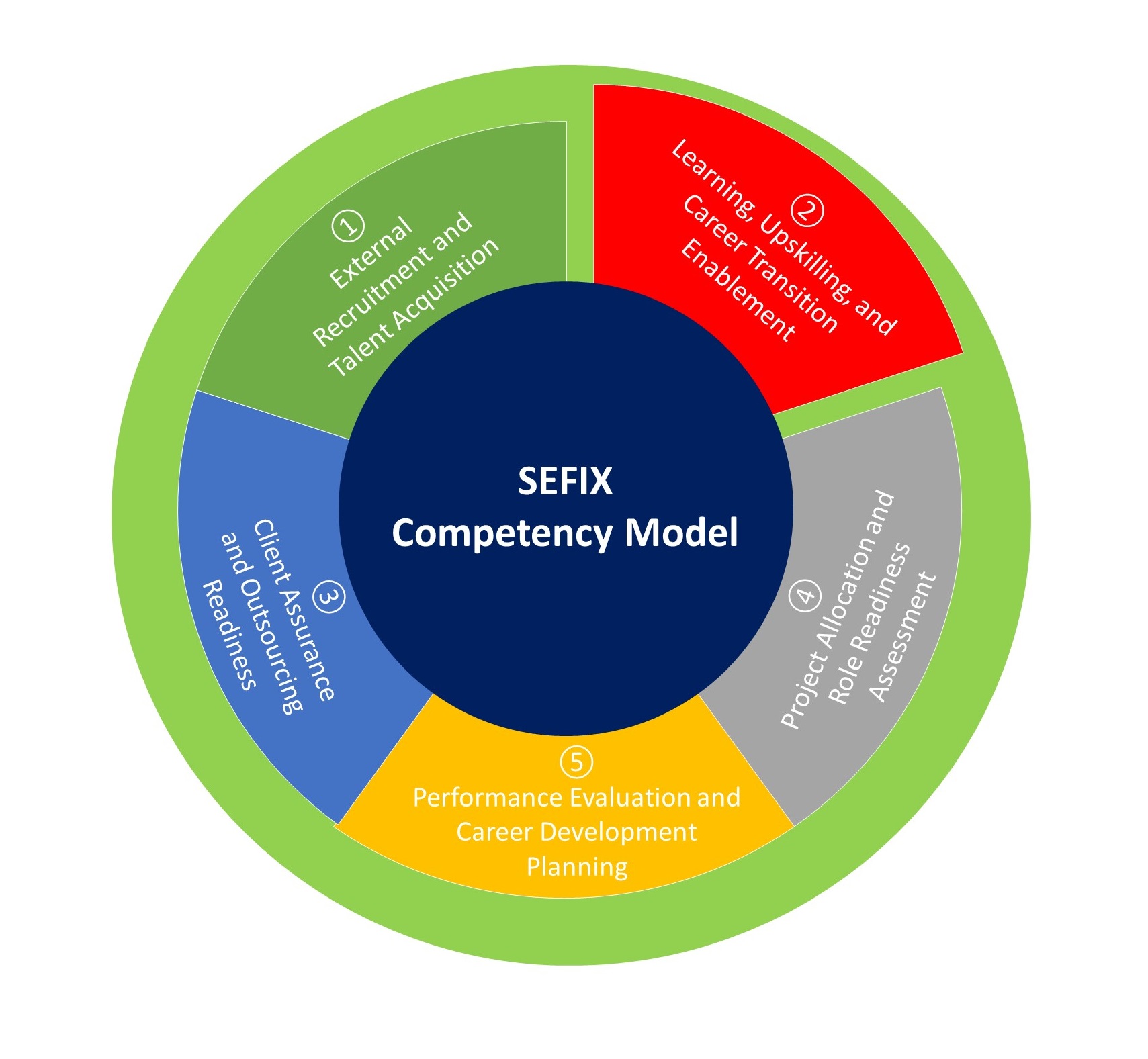
SEFIX Competency Framework’s Objectives
The Competency Framework (CF) and Job Description (JD) establish a formal and consistent basis for defining, assessing, and governing workforce capability across the organization. Together, they specify the required responsibilities and accountabilities (R&R), skills, knowledge, behaviors, experience, and expected contributions for each role in SEFIX career framework. The job description constitutes an official and authoritative reference document and shall be used for the following purposes: Assess → Develop → Validate → Promote → Reskill → Reassess
1. External Recruitment and Talent Acquisition (ERTA)
To formally define and publicly communicate role requirements for the purpose of recruiting qualified external candidates in accordance with company hiring policies and standards.
2. Learning, Upskilling, and Career Transition Enablement (LCTE)
To provide a structured reference for designing learning and development pathways, enabling employees to understand the competency requirements for assuming or transitioning into the role and to plan necessary upskilling, reskilling, and practical experience.
3. Client Assurance and Outsourcing Readiness(CAOR)
To demonstrate to clients and external stakeholders that the company’s workforce possesses competencies aligned with contractual, regulatory, and delivery standards required for outsourcing and professional services engagements.
4. Project Allocation and Role Readiness Assessment (PARA)
To assess and validate whether employees assigned to projects meet the competency requirements necessary to perform the role effectively and to manage delivery risk.
5. Performance Evaluation and Career Development Planning (PECD)
To support formal competency assessment by enabling employees to conduct self‑assessments, and by enabling managers and leaders to evaluate individuals currently performing the role, identify competency gaps, and define targeted development and career progression plans.
Implementation
5 Objectives and 5 types of job description documents are established to ensure full transparency of the competency framework across organization (divisions, departments, oversea branches, business units) and to provide a clear, consistent, and authoritative reference for roles and expectations.
By clearly articulating responsibilities, required competencies, and proficiency expectations, the job descriptions enable employees to accurately understand what is expected of them, align individual career aspirations with organizational needs, and plan appropriate development actions.
Through this transparency, SEFIX competency framework aims to set the right expectations, promote fairness and consistency in assessment and deployment, and support effective workforce capability development in alignment with business and client requirements.
Division Inputs & Outputs
The Division Inputs & Outputs model provides a structured view of how each organizational division contributes to workforce capability. Inputs represent the demands, requirements, and information flowing into a division, while outputs capture the actions, deliverables, and results produced.
By mapping these exchanges, the company ensures transparency, alignment, and efficiency across recruitment, training, resource allocation, client assurance, and career development. This approach highlights the interdependence of divisions where Business Units define needs, Workforce and Resource Assurance execute recruitment and validation, HR governs employee lifecycle, Training and Development Centers deliver upskilling, Idle Workforce Center manages redeployment, and Overseas Branches extend global alignment.
Together, these inputs and outputs form a cohesive system that drives organizational readiness and sustainable growth.
| Objective | Primary Divisions | Supporting Divisions | Responsibilities |
| 1. External Recruitment & Talent Acquisition | WA, RA | BU, HR, OB | BU requests new hires; WA/RA run recruitment & headhunter centers; HR manages contracts/onboarding; OB supports overseas hiring. |
| 2. Learning, Upskilling & Career Transition Enablement | CTC, DC | WA, RA, BU, IWC, OB, HR | BU defines skill needs; WA/RA validate competency gaps; IWC identifies idle staff for reskilling; OB adapts training globally; CTC/DC deliver programs; HR tracks career transitions. |
| 3. Client Assurance & Outsourcing Readiness | WA, RA | BU, OB | WA/RA validate workforce competency against client standards; BU ensures project-specific compliance; OB ensures global readiness. |
| 4. Project Allocation & Role Readiness Assessment | IWC, RA, BU | WA, HR, OB | BU requests allocation; IWC manages bench resources; RA validates readiness; WA supports assurance; HR formalizes assignments; OB manages overseas deployment. |
| 5. Performance Evaluation & Career Development Planning | HR, WA, BU | RA, OB, DC | HR manages evaluations; WA ensures competency alignment; BU defines career paths; RA validates skills; OB extends evaluations globally; DC supports career progression through development programs. |
Mapping of Divisions to Objectives
The Mapping of Divisions to Objectives establishes how each organizational division contributes to the five core objectives of the competency framework. It highlights the flow of responsibilities across recruitment, learning, client assurance, project allocation, and career development. Business Units define demand, Workforce and Resource Assurance execute recruitment and competency validation, HR governs employee lifecycle, Training and Development Centers deliver upskilling, Idle Workforce Center manages redeployment, and Overseas Branches ensure global alignment.
By mapping divisions to objectives, the company achieves transparency, accountability, and synergy—ensuring that every function supports workforce capability and organizational growth in a coordinated manner.
| Division | Key Inputs | Key Outputs |
| Human Resource (HR) | Policies, contracts, employee records, career aspirations | Formal hiring contracts, onboarding, performance evaluations, career development plans |
| Workforce Assurance (WA) | Client requirements, competency standards, BU requests | Recruitment execution, client assurance reports, workforce readiness validation |
| Resource Assurance (RA) | Competency frameworks, BU skill demands, IWC resource pool | Recruitment validation, resource allocation approvals, competency gap analysis |
| Idle Workforce Center (IWC) | List of idle employees, skill profiles, BU project requests | Redeployment of workforce, upskilling needs identification, allocation readiness |
| Corporation of Training Center (CTC) | Skill gap analysis from WA/RA/BU/IWC, global standards | Training programs, certifications, reskilling pathways |
| Development Center (DC) | Career transition plans, advanced skill requirements | Specialized development programs, career progression support |
| Offshore Development Center (ODC) | Global project requirements, BU/OB requests | Offshore delivery capability, resource deployment overseas |
| Business Units (BU) | Project pipeline, client demands, skill requirements | Requests for recruitment/allocation, definition of competency needs |
| Overseas Branches (OB) | Local market needs, global standards, BU requirements | Local recruitment, training adaptation, global career development alignment |